Labels

Showing posts with label Criticism. Show all posts

Thursday, 27 June 2013

Upcoming Publication: "Where the Hood at? Man's Great Question Solved"

Over the years many intellectuals have asked perhaps the most precient question of our time, "Where the Hood at?" Now, for the first time and thanks to several months of deep investigation, in which I lost contact with my family, friends, even my own children going ignored, their feeble cries for sustenance put aside as we all withered under the relentless yoke of my passion, all this waste, all this death, all this suffering, but now culminated in my seminal publication, due out this autumn, "Where the Hood at? Man's Great Question Solved by Recource to Grecian Methods, Namely that of the Pythagorean School, Incorperating Elements of Dadism, Sadism and Hegelian Notions of History." The book where this most fundamental question shall be answered.

When DMX first queried, he doubless expected, in some far corner of his almighty concious mind, that the answer to his puzzle would be found, naturally, in geometry. Of course! For is it not the preserve of the shape, the mighty abstract forms made concrete, location of universal space, and, so it follows, the enigmatic location of the Hood?

Like Arthurian Heroes of yore I followed the sage words of DMX, my cyberage Merlin, as he pointed me towards the Grail that was the Hood. Though, unlike Arthur, my quest was not to be found in the forests and glens, marshes and moors of ancient Albion, No! It was to be a mental oddessey, and so I cut myself off, reaching for gnosis, trancending space so I may look from above like the noble eagle whose entrails I so carefully read, and see the seat of the divine, the illusive Hood.

And now, for your delectation and delight, yonder diagram below illustrates the summation of my efforts. As you can observe, the Hood is in fact located in the last vertex to the right of any irregular triangle.

fig, A: The Location of "The Hood"


What secrets lie there, immortality, trancendance, gold, hennessy? For the answer, seek out my upcoming book, "Where the Hood at? Man's Great Question Solved by Recource to Grecian Methods, Namely that of the Pythagorean School, Incorperating Elements of Dadism, Sadism and Hegelian Notions of History."Available at all morally decent bookstores.

Adeui,

Barrabas

Wednesday, 30 January 2013

Fingers and hand

Tangled ganglion, fingers, appendages of activity, poke the mind of god. Fist is block, sponge, flanked and mounted by five sticks. Organelles of functions, divide my mitosis, rather like frogspawn. Property of a nincompoop. Absurd devices prehensile. Silly. Fingers and hand. God's joke.


Thursday, 10 January 2013

Words from a Homeless Man

I don’t think you can count being a beggar as being part of a counter cultural movement, I said to the leper. He had fruitlessly tried to argue that each era had its own revolutionary cultures, which all, regardless of look or circumstance, consisted in entirety of irredeemable ponces, and that intransigents such as he were the Wildes, Lenons, etc of this era, clothed in filth but with the self satisfied look of great intellectuals or babes who’ve shit their nappies.
Empty globe eyes and the dumb nose of the dog pointing upwards in anticipation to catch a fractal raindrop maladjusted in decemtum. Young men dressed as contemporary fairies walked past with pompous look of the freshly sodomised. Flowers sprout around with hippy fronds in Technicolor. The beggar was adamant and I had a French bus to catch. A Parisian, always artfully late, belching smug. I wondered why all the homeless wear berets and paint their faces like mimes. He doesn’t silence, so I hobble him and let the plants have him. Vicious geraniums. And why is the bus stop a log? All about are insects going about their daily business, beetles in suits buttle to the office, ladybugs get into place as secretaries, woodlice the builders. And the growing flowers cover all.
 Above it all I walk away from a similar but different beggsr to catch a train made of Belgian chocolate that travelled along sugar rails. Halfway to Nashville I ate through the coupling bars and caramel cables and accidentally derailed my carriage, which turned to glass about me, shattered and became water which fell around into an oriental mud river, with multicoloured villages sitting, living on houses raised above it on stilts. They plot acts of global terrorism with plans that are 50 years old, and one day they will pull it off, very bond villain, very peculiar, the sound of a rolling metal tongue, lightmares and nightning, blue and silver flashes in the desperate void. Black is the colour of between space-no colours so objects in the way, you look out and see the void, what exists before and out universe. It is sterile, changeless, produces nothing. Then it gives birth to creation. Rapid expansion from a point, almost like human birth - why so similar? Conspiracy? Fragmentation becoming severe, ideas dissacoiate like alien limbs in zero gravity, spaceship logic falls at the first hurdle and has to be put down, is in a bad mood for another week, weak fool to try and waste his hard effort on the futile endevours of men and of mice which always reach maximum termination at the back of the microwave and are governed by an inhospitable terror bird, code named squark, who actually squonks, the sound made when two frogs are forcibly pushed together until rupture, similar to how the polish monarch of 1153 used to wear shoes with frogs on the sole and jump about his palace yelling ribbit, until he was assassinated and his dynasty supplanted by pagan planks of wood who were later overthrown by papists, but not the papists of andulasia who were not-o-rious pederasts and big biggie fans, instert component B into slot F, gyrate with your partner then separate for two beats, on choral medley strip off and assume intercourse position alpha, and recite mantra of the lecturous, later found as recorded on a stone tablet by a dystopian empire run by a puppet government of humans rules by physic rabbits, who use them to fight their principle enemies, chicken, pig and cow.

-The deranged rantings of the man I met at the bus station.

He was homeless and raved, but I saw that there was an evil in this homeless man, he drives others to his state, entraps them, swaps with them.

Thursday, 2 August 2012

A thought


  • 1.) (premise) I exist in the present
  • 2.) (premise) I existed in the past and the past is something "real"
  • 3.) (premise) I have free will and the future is undetermined. 
Conclusion "I" am a growing '4D' time worm and "I" can shape my identity

Inferences:

IDENTITY IN AN FINITE UNIVERSE
1.) If I only live once my identity is valuable only in some abstract way, and hence not of any particular concern.

IDENTITY IN AN INFINITE UNIVERSE

  • In an infinite universe reincarnation necessarily follows (as given an infinite time everything that is possible becomes actual) 

If identity is directly shaped by my actual moral/experiential deeds then "I" could only exist where "I"  performed similar actions to those that I performed in my actual life or in a life where I felt the results of those actions.


Thus if "I" were to be reincarnated I would have to perform similar deeds in all subsequent infinite reincarnations. 

Thus I should pick my actions very very carefully indeed.

COUNTERARGUMENT 1

Life whether finite or infinite is imperfect so it’s not all that important to “choose” our identity right, if indeed we can choose our identity. Indeed many things are beyond our control and as long as we have a reasonably ok identity then it is unrealistic and a waste of effort to aim for a much much greater life..


COUNTERARGUMENT 2

Rigid identity and an infinite universe necessarily impliy determinism. (i.e. i was always performing these deeds in an infninte chain with no beginning or end) So I can't change my identity even if I wanted to.


COUNTERARGUMENT 3

I only have control of a small part of what shapes my identity (my actions), bad things still happen if I do good things.

Wednesday, 1 August 2012

Confessions of an evil man

TWO ARGUMENTS IN FAVOUR OF BEING A DICK


FIRST ARGUMENT: MORALITY IN AN IMPERFECT UNIVERSE


Three preliminary points:

1.) Imperfect things have imperfect value.

2.)The universe in imperfect.
3.) People belong to the universe thus they are imperfect, and their wllbeing has finite value.

PROOF OF 2


FOR THE PERFECT UNIVERSE TO BE ACTUALISED THE FOLLOWING KEY DESIRES MUST BE FULFILLED:

a.) We do not want to be ultimately accountable to somebody else – we want pure free will: Atheism

= Plausibly true at this world

b.) We do not want the universe to be dependent on our thoughts – we want the external to be real: anti-idealism

= Plausibly true at this world

c.) We do not want to know we live forever - If we knew we lived forever life would be meaningless thus we want a period of forgetfulness between lives: reincarnation

= Not necessarily false in this world

d.) We do not want to suffer unnecessarily

= It is almost certain we do suffer unnecessarily

CONCLUSION: IT IS ALMOST CERTAIN THAT SOME OF THE ABOVE KEY DESIRES ARE UNFULFILLED THUS
THIS IS NOT THE PERFECT UNIVERSE


From 1,2,3,: A slippery slope. 


If it is morally justifiable to spend 99.99999...% of my energy on morality then it is morally justified to spend 99.9998…% of my energy on morality. Because of the insignificant difference between the two figures.

- It is morally justifiable to spend 99.99999...% of my energy on morality because people's wellbeing has finite value.

It is morally justifiable to spend 99.999998...% of my energy on morality
THUS

It is morally justifiable to spend 99.9997…% of my energy on morality. BY TRANSITIVITY OF RULE

Etc. etc.


It is morally justifiable to spend 5.99999999...% of my energy on morality

THUS it is morally justifiable to spend 5.9999999998…% of my energy on morality.


Conclusion: I can be a dick


ARGUMENT 2 THE ARGUMENT FROM SELF-PRESERVATION

2.) It is justified to hurt somebody a little to avoid a very large amount of pain yourself– SOME VALUE COMMENSUARABILTY

OR At some point avoiding pain becomes objectively more important than a little immorality.


2. a) Slippery Slope

If I can hurt somebody for 1 unit of pain in order to avoid 45000 units of pain myself I should do so.

If it is morally justifiable to inflict 1 unit of pain on somebody in order to avvoid 45000 units of pain then it is morally justifiable to inflict 1 unit of pain in order to avoid 45999 units of pain. As the difference is insignificant.


Etc. etc.
THUS BY TRANSITIVITY OF RULE

- If I can hurt somebody for 1 unit of pain in order to avoid  0.1 units of pain myself I should do so. 

Conclusion:I can be a dick


Tuesday, 31 July 2012

The Olympics as the triumph of Thanatos over Eros.


With the Olympics near I turn my learned mind to the topic of competition. Competition is in essence the embodiment of the death drive, the desire to subdue and defeat your earthly brethren, the angry face of nature, red in tooth and claw and glans and wizard’s sleeve.


Wednesday, 18 July 2012

Fictional Dictionary


Crebules – a borough of London city

Yopus – Trousers

Crebulosophpous – The core of a loaf of bread

Filligerubestop – A worm

Gipper- A title of honour (often academic)

Boonoceriousap major – A comet orbiting the constellation of Scorpios

Craspos - a fluid or essence that, though familiar, exits the body via the wrong orifice

Posterperfidy - to be famous for a petty crime

Finbrae - a diseased end

Saturday, 7 July 2012

Arnie is a Nephilim.

Schwarzenegger certainly has the look and feel of a nephilim, the broad cheekbones, the political success, the angelic frame. Though this is not evidence enough, it certainly casts aspersions on his angelic status.  But we must look closer at his film career, and indeed his policies to discover his true nephilim self. But you say Elohim created the nephilim, driving them from their celestial sphere in the heavens down to earth, where they were to dwell with the sinners adam and eve. Why Schwarzenegger, he was born some six thousand years later and the bible mentions nothing of him!

Or does it? Remember Samson, those beautiful flowing locks, the sword or bone used to fight with, the piercing eyes, and the immutable ambition? The man who said "let me die with the philistines!", and thought that the greatest thing in life was to crush his enemies see them driven before him, and to hear the lamentation of their women! Does Samson the man with a weakness for the ladies and a penchant for oiling up his bared torso remind you of anybody?


Yes indeed, Arnold Schwazenegger is nothing more than an alias, that the ancient biblical Samson (a nephilim) has chosen to mask his true identity. He has existed for millennia, casting down his enemies, brutally ousting his political opponents, sleeping with maids, and pumping iron. I take my hat off to him and bow down in reverence.


Thursday, 28 June 2012

Society and its ills


“Society” and its ills

 
Man is no longer free to gaze at the heavens and feed his mouth with the fruits of the earth. He cannot lay down by the green pastures and sip from the flowing brook. He cannot use his cunning and might to cudgel a monkey to death and roast its tortured body over a fire, or by his choosing, spare it! He is not free to explore the jungle-earth in search of knowledge, bounty and riches. He cannot build his own house, and till his field with his own two hands! He is not permitted to murder his enemy in some bitter and honourable dispute. All these things are owed to man, and yet the wicked and greedy, the cowardly, the boastful, the arrogant, the self-seeking and the proud have mechanised existence. They have made a wall around their ill-gotten gains in the form of laws, precepts and duty. Man in society has become a schemer, a plotter and a fiend.


A MANIFESTO


THE ILLS OF RELIGION

Religion bends man’s lusts and inward and turns him into an unnatural sex pest, like a catholic priest.

-THUS Priests should be encouraged to engage in coitus

Religion rationalises by the medium of fear the natural wonder of existence that is proper to us all

- THUS Priests should be prevented from using fear as a coercive tool and must be compelled by law to use the Children's Bible, instead of the actual one.


THE ILLS OF THE LAW

The law prevents due revenge and vengeance which is every man’s right, by offering retribution by proxy.

- THUS a law should be in place that allows the wronged to punish the wrong doer. The boats, the breaking wheel, head crusher and crocodile shears are all possible legal punishments.

The rich and greedy own the land which belongs to all of us and take the food from our mouths!

- THUS a large tax should be levied against the rich and the gains distributed for the good of society.
- THUS the richest man in society must be made to toil in a rubber fist mine for a year

A man must pay for the very ground upon which to build his own house!

- THUS each man, without exception should be allotted a plot of land for his quarters
- THUS machines should till communal fields in place of man, and pick the orchards, and bring the food to him and the community.


THE ILLS OF THE FACTORY

Man utilises the means of production to sell useless items and indebt their owners

-          THUS man should create more drug factories, to create a cheap supply of products
-          THUS man should create a GM bird that he can ride and feed oats or some such cereal instead of building a car. 


Wednesday, 27 June 2012

The meaning of life

Gentlemen, I present to you with all due modesty, THE MEANING OF LIFE.

AND

THE ULTIMATE METAPHYSICAL NATURE OF BEING:

1.) Being, i.e existence itself has no inherent meaning

2.) It is our desire to create morality and meaning in the world


MAN URGES HIMSELF TO GIVE MEANING TO A MEANINGLESS UNIVERSE

MAN URGES HIMSELF TO GIVE MORALITY TO AN AMORAL UNIVERSE


As the sole enforcers of this type of behaviour, we could choose not to act in a meaningful way as there is no punishment for disobaying the rules. But this is to miss an opportunity.

Metanormative dialectic


I have of late been wondering how to roll the perfect joint. I told  the wizard Wolfram Alpha my query and this is the pith of the response:


raises more questions than it asks

Sunday, 17 June 2012

Yukio Mishima and the love of St Sebastian.

st sebastian with erection
It's not my bag


It is Sebastian’s almost base physicality and masculinity that instantly strikes us, upon viewing this painting. The dark shadows, the harsh lines, the piercing gaze, the massive semi-erect penis. If not for the arrows one would imagine the image to be designed for the purpose of proudly displaying a person’s authority and achievement. Sebastian in the picture stands erect and exclaims ecce homo – behold the man!

Yet there is a white elephant in the room, Sebastian this symbol of masculinity is seen in the painting as being ravaged by a swarm of arrows, (an obvious reference to the traditionally dominant phallus). Why is Sebastian a paragon of masculinity so often portrayed as being humbled by the phallus? Why is this sadomasochistic perspective seen as so erotic by writer’s such as Mishima? For the answer to the latter we must look deep into the mind of the great poet and writer.

Mishima’s childhood was rife with difficulty, he was often sick with tuberculosis and and was only allowed to associate with “weaker” female relatives for fear he would be bullied by boys his own age. In the beginning of “Confessions of a Mask” Mishima often escapes the sufferings of worldly existence by escaping into a world of sadism and dominance. His actual sufferings giving rise to imaginary sadistic triumphs. As Mishima grows this striving for dominance takes on a sexual aspect, he writes:

“I cried sobbingly until at last those visions reeking with blood came to comfort me. And then I surrendered myself to them, to those deplorably brutal visions, my most intimate friends.”

It is logical to assume that in the case of Mishima this early repression of the will to power led to a rebound of the ID – an explosion of sadism. The will to power that had been repressed and denied him in his childhood grew exponentially more violent in adulthood. Yuko Mishima strives from his mid twenties to be a real-life Sebastian, ceaselessly exercising with heavy weights, each day trying to fit his ever bulging muscles into his spandex pants.  Tiring to become like the heroic and ever masculine Sebastian.

Sexy


We see in the life of St Mishima then a pattern, a childhood of submission, a rebound and an adulthood of sadism and dominance.

And yet like Sebastian Mishima wants to die, and indeed declares that it would gratify him, to "die among strangers beneath a cloudless sky".In November 1970 Mishima commits Japanese ritual disembowelment (seppuku) in the back room of a military compound. For the reason why we must look to Sebastian.

Sebastian is the key to Mishima's entire oeuvre. As Mishima plunges the blade into his abdomen. He is reduced once more to his childhood weakness and surrenders to the power of death.  Mishima who strove all his adulthood to become masculine is seen here secretly craving domination and the power of another man's willy (represented by death).  Thus Mishima the Sadist becomes the Mishima the Submissive in death, completing his darkest desires and finally creaming his pants. Mishima is not only a sadist but a masochist and indeed his masochism finally overpowers his potent sadism.

RIP

Saturday, 2 June 2012

Peter Jackson's Movie Trilogy Lord of The Rings: A Fertility Parable

 Argument


Just Friends, OK.
Any study of The Lord of the Rings will always be coloured by the obvious controversy that still abounds regards the relationship between the primary protagonists, Frodo and Sam. As People Magazine famously quipped, ‘did they do it?!?!’ However, I believe under this flaming tale of unrestricted gay desire there is something deeper, even more elemental than a mere craving for Hobbit booty. Therefore leaving the explicit commentary of Frodo and Sam's relationship concerning the fluid boundaries between homosocial and homosexual behaviour in a male-male partnership to one side, here I shall instead consider the implications of Lord of the Rings as a Genesis-type fertility parable, if you will.

This analysis will primarily focus on the mortal races; it is clear the elves in Tolkien's strict catholic prose are allegories for and synonymous with the Nephilim, an immortal, angelic race possessing superior physical capabilities from a far off location (The Heavenly Firmament, The Grey Havens) who mate with mortal mankind (consider Aragorn and his hot elf ho.)

Despite this, there is still much argument in the academic community at how far such an argument can be taken. Is this epic a thinly veiled portrayal of overcoming infertility, represented by the forces of darkness, the orcs who cannot love or make dirty coitus, who are birthed from the earth itself? Sex is everywhere and nowhere in Tolkien, omnipresent and yet denied even when at it's most obvious.

Genesis 6:1-3 When men began to increase in number on the earth and daughters were born to them, the sons of God saw that the daughters of men were beautiful, and they married any of them they chose, then the LORD said, "My Spirit will not contend with man forever, for he is mortal; his days will be a hundred and twenty years."
Therefore here I will consider both an argument for, and an argument against a reading/viewing of Lord of the Binge as an ancient Mesopotamian Fertility Epic.  First Sam the inseminator will be considered, and then an opposite argument using Éowyn as an example of female independence.


An Argument For Fertility: Samwise "The wise" Gamgee, Professional Gardener, Gimp and Fatty.


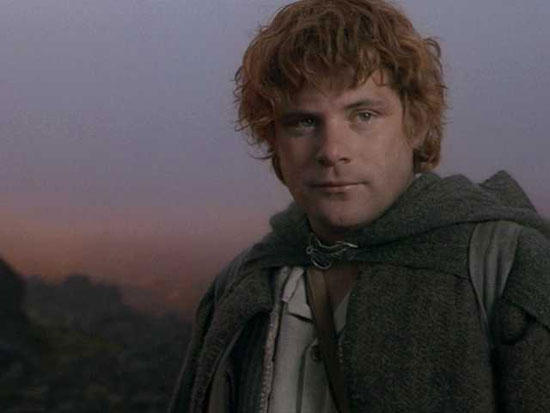
Brooding
Sam is perhaps not the most obvious character with regard to fertility within The Lord of the Cock Rings, given his oft regarded romantic relationship with his 'employer' Frodo Baggins. While this commentary on social exploitation of the working classes through a subliminal BDSM narrative implicit in their relationship is fodder for a separate analysis, it may be productive to consider it briefly here.

The Worker's Struggle
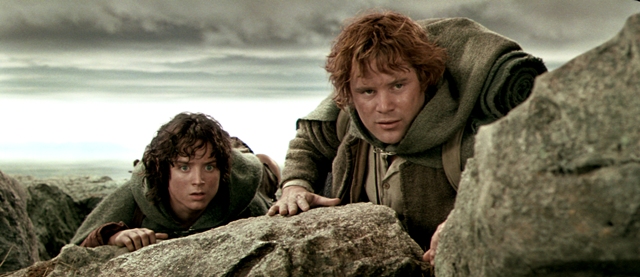
Sam is subservient, oppressed, scorned, and yet loyal like a lobotomised cocker spaniel to his master Frodo. He is the only one shown cooking, or performing many of the other necessary activities on their extended camping trip. Meanwhile Frodo sits on rocks or tufts of earth, sweating, mewling, and looking into the middle distance. Is this, as Wilde put it, "the love that dare not speak it's name"? Or is it instead a comment on the exploitation of lower classes by a fundamentally weak and unstable oligarchy, here represented by Frodo. Once the police and army break down (here symbolised by the Fellowship, particularly Aragorn, and the spilt at the end of the fist book/film) little stops these two polarised groups from coming into conflict, culminating in Frodo's dismissal of Sam. Like the horse Boxer in Orwell's Animal Farm, Sam is loyal to the last, even when it conflicts with his own interests. Perhaps this is a comment on modern media's ability to be used to penetrate and manipulate the masses into voting against their interests, or perhaps it is too early to say.

However, Frodo finds that, abandoned by Gollum, representative of decedent and unrestrained desire, he needs his 'dear Sam.' At this moment the typically passive Sam comes to the fore, and slays the spider Shelob. Is it any wonder that such a brazen allegory for the web spinning ability of contemporary middle and upper class consumerist culture is a giant spider? It seems facetious to think otherwise. Here, unlike Boxer's fixation that "Napoleon is always right," Sam has finally transcended the yoke of the lower classes, and taken control. However, he has done so to rescue his educated master. The masses cannot survive, it seems, without some educated elite to guide them, though this elite must be now weakened, as the ring weakens Frodo. Now, as in Mordor, it is the masses who drive the nation forward, as Sam carries the feeble Frodo to Mount Doom.

With this brief aside in mind, it is now time to turn to the case of The Lord of the Onion Rings as a parable primarily concerned with Sam's fertility, and his claiming of Phallic privilege and exclusivity of procreation with the hobbit slut barmaid Rose "Rosie" Cotton.

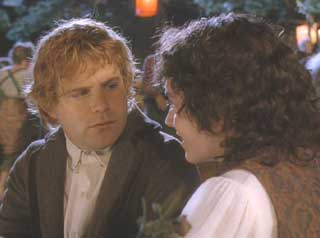
Before Sam's adventure he desires this woman Hobbit wench, but is unable to act. His fear and his subservience overcomes his masculine urge for coital intimacy. Here Frodo is seen as the a-typical 'bro' at the party. Beer is flowing, the wenches are dancing and Brodo tries to convince Sam of the virtues of making a move. Frodo is a capable wingman, but he fails. Sam does not get lucky. He is paralysed by fear of the female, especially in it's most seductive of forms, Rosie. Paradoxically it is her very appeal to him that causes him to be unable to approach her.

Bro-do and Sam Mid Party


On his return. however, Sam is a transformed man. He asserts his masculine phallic authority by siring thirteen children from his woman while she is of healthy mating age, and, not content with his dominance over the female other, he asserts control over the male population through his long career as Hobbit Mayor, a role equitable in contemporary terms with the powers of the Deputy Prime Minister. Though he is arguably in a position of power of the 'little folk' of the Shire, in reality his influence is negligible on the wider Middle Earth stage.

Nevertheless Sam has asserted himself as fertile, although like Abraham it took a journey and many hilarious adventures to achieve it. This is in direct contrast to Frodo, who returns a celibate monk compared to his prior bro-ishness. The two roles have become inverted by associated and overexposure; just as proximity to the Ring warps Frodo closer to it, the time Frodo and Sam spend together, huddled together for warmth on cold and rainy nights gives rise to a mimetic transformation. They come to emulate each other, and slowly become each other. Frodo becomes the feminine, whimpering supplicant to Sam's proactive masculine heroics.

However, a spiritual transference with Frodo is not the sole source of Sam's new found fertility; that alone has not given new life to his withered seed like Elisha in the Valley of the Dry Bones. While in the Shire, Sam is exposed to the endless and bountiful exuberance and vitality of the Hobbits, and their undeniable fertility. As a result he feels lost, unable to compete with their happy harvests, another sign of fertility, in the very earth itself. As a gardener Sam understands this; he can nurture flowers and vegetables to maturation, yet he cannot create life himself. His very profession is an endless reminder of his impotence. No wonder he takes to practicing it outside Frodo's window in the middle of the night; in the daylight, his flaws are too apparent for him to be able to stomach.

But in his travels, Sam passes through lands barren, or ravaged by war. Weathertop, Moria, Icthillion, Gondor, Osgiliath, The Misty Marshes, Emin Muiel, Minas Morgul and finally Mordor itself. All of these locations have been made infertile, unable to support or produce life any longer. They are simply places of death, of perpetual conflict. As Homer puts it in the Iliad, 'war never ends.' The war in these barren climes is total and immortal, and in the face of all this destruction of life Sam becomes aware of his own life and fertility that he carries within himself. A sense, perhaps, of 'heroism' this becomes more and more pronounced in Sam the more adversity he faces. Sam discovers his internal fertility when set against the bleakness of Middle Earth, it is the only way his psyche can survive the trauma of war he witnesses. To escape the effects of PTSD, Sam externalises his inner peace, his inner goodness, and is able to conquer the darkness. Furthermore, when he gets home, he brings this fresh ability with him, and is able to seduce and procreate with a vigour that would put a rabbit to shame.

"Mister Frodo, she's at least an eight. Dibs."


 An Argument Against Fertility: Éowyn, The Sterile Warrior Mother

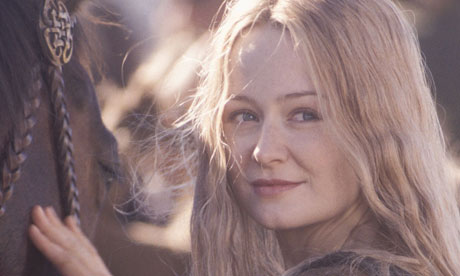
However,  Éowyn seems to turn this fertility narrative on it's head, or at least provide a female counterpart to Sam's 'male mothering' of Frodo. Her repeated attempts to penetrate masculinity and overcome her natural femininity and the prejudice that occurs see her struggling against the very idea of fertility and the female role as a vessel for procreation. Her people are 'horse lords' and the horse has long been a symbol of unfettered virility and masculine expression. She is a (frumpy) woman cut loose in a patriarchy where a man's worth is measured by the length of his beard and his ability to shout.

What a Horse
 However, Éowyn blends masculine and feminine gender roles to create a hybrid persona which fits both her ambition but also her maternal urges. Against her father's wishes she sallies out to battle, and, as well as slaying many disgusting (totally not Moor allegory) orcs, she kills a motherfucking Oliphant. The destruction of this masculine symbol of phallic compensation shows her triumph over the patriarchy through emulation. She acts like a man, she fights like a man, she is a man.

And yet she achieves something more. By bringing along the small, boyish Hobbit Merry, she plays the role of his surrogate mother. Under her influence he transforms from a foolish young rapscallion into a man, a warrior in his own right. She guides him in a second childhood, and both of them act out the child-mother relationship.  This is a relationship that oozes in Freudian tensions and desires. Merry is clearly in love with his mother, and sexually desires her, but, due to his tiny Hobbit manhood, is unable to meet her demanding needs, finding himself eventually replaced by Faramir, another Surrogate she nurses back to health from near death. Here she is able to project her maternal desires onto a male of the same race, and as a result is also able to finally consummate her otherwise sick and twisted desires. Merry is left jilted, but learns from this experience. His true love lies with Pippin; both Hobbits, though in rival factions like Romeo and Juliet in Shakespeare's Romeo and Juliet, have achieved martial prowess, and as such affirmed their masculinity. No longer in crisis and feeling emasculated and vulnerable due to their diminished stature. they are able to consummate their love without these insecurities which previously prevented them from opening up their hearts to one another.

Another Hobbit Fantasy

However, by finding and rearing a surrogate son, Éowyn forgoes coitus in preference to an immaculate conception of sorts. She will not submit to the patriarchy, and as such will not suffer to be made vulnerable by the sexual act or by pregnancy. Her role is sexually gendered masculine at all times, hence the penetrative sword she brandishes. This is the sword with which she slays the dreaded Witch King, itself an gendered oxymoron playing on concepts of the evil (fe)male monarch, providing an empty 'other' onto which she can project herself and her virtues as she now becomes a female monarch with the death of Theoden.

Finally, by severing the phallic neck of the Fell Beast and removing it's aggressive, drooling head, Éowyn is asserting a new type of female masculine virtue. She is both an emasculator, a castrator of men in the mould of the bride from Kill Bill, but also very much a woman, protecting herself and the king from a violent 'rape' at the maw of the Beat. There is no need for the phallus in the new word Éowyn creates for herself, the final symbol of the patriarchy has been undone. She has made herself wilfully sterile, and yet also a mother. Men have no control over her or her reproductive ability, instead she is the commanding mother to men.

Pre Castration

Sunday, 15 April 2012

Kitsch Art as an imitation of reality

Plato believes there to be a hierarchy of loves.

3.) The love of a woman by a man
2.) The love of a young boy by a teacher
1.) The love of the Forms.

If love of the Forms is the highest of the three loves then where does "the love of art" fit into this picture? A painting is not a woman, or a young boy and so it seems it must fall under (3) the final category. But a painting or, or indeed a sculpture or a photograph is in a sense a portrait of something material, something corporeal. Now the material world according to Plato is only an imitation of the Forms, those perfect objects that exist in the Platonic ether; the perfect chair, the perfect number 5, the perfect goose etc.

If one strives then to paint "the perfect chair" can one really rival the glory of the Form in all its celestial grandeur? If it is the case that art can never live up to the reality of existence and to the beauty of the actual then art must strive for something other than imitation. Art must strive for the novel, the fresh and the challenging.

Fine art


Friday, 16 March 2012

Evidence of Retrospective Templar Intrusion into History

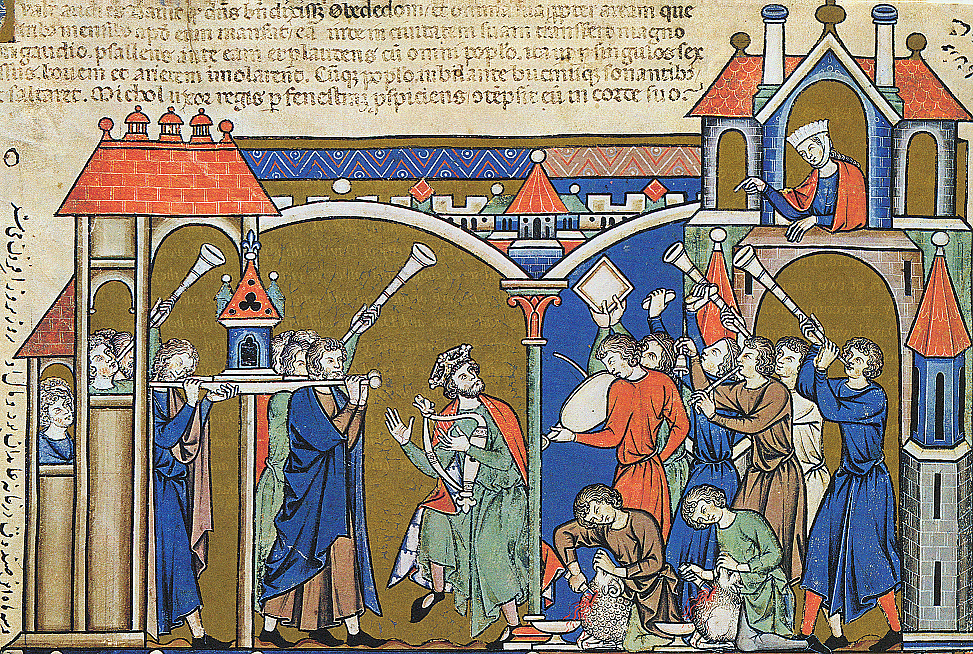
It cannot be denied that that, during their occupancy of Solomon's Temple in Jerusalem in the twelfth century, the Knights Templar discovered buried under the rubble of the new Temple, and, through diligent excavation, uncovered the means totravel through time. This is an indisputable fact. The nature of the mechanism, though now considered lost (while actually held by the Rosicrucian Ministry of Obama and his Past Truth Redactors) is known to us. For though history can be destroyed, knowledge cannot be. The device was nothing more than the Ark of the Covenant itself. By careful manipulation of the sigils, a Heirophat could alter the course of history itself, and disrupt the harmony of the Time Continuum.

Templar Desecration of the Ethereal Time Vortex

The Templars found this, and the arcane knowledge of how to operate the holiest of holies, which YHWH had intended to keep hidden amongst the ruination of the failed children of Israel. And ever since they have been redacting time, re-forging history to suit themselves and their evil machinations, even going so far as to create themselves by intervening in a past where they did not exist. This is why the armies of YHWH and his angels cannot defeat them; they exist both within and without time, are an artificial abomination imposed on creation from outside, some parasitic force attaching itself to time and space and leeching off all piety and joy; the devil himself, Satan, or as he is modernly known, O'Bam'Aaah.
"Fear me and my Mighty Time Vortex" -White House Press Release June 2011

Yes, the Templars created themselves in a time paradox by travelling back and crucifying a regional holy man, a small time wizard who came to be known to the world as the great pretender, Jesus Christ. Evidence for this time distortion can be seen in the ripple like effects it produces as it renders reality in twain. By slaying Christ, they gave cause to their existence, and with it uncountable human sufferings. The evidence for Templar Intrusion into history will now be briefly summarised.

a) The Sage Merlin and the Presence of the Graal

Merlin, a fellow time distorter, has often visited me and imparted some of his immense knowledge to me. And he has spoken to me of a world, an existence without Christ. The perpetual Empire of Romanus, the rise of the age of enlightened reason. He has provided me with scrolls to prove the existence of separate temporal realm, and I have no cause to doubt him for his knowledge is unequiable, his articulation profound, his stench horrific. And he brought me a relic of his journey to the moment at which the cursed Templars intervened. The perfect Graal, the chalice of Christ in which his blood was drained and supped by the high Lord Dragon of the Templars. Though Arthur fought them in a hard and difficult struggle through time and space across millions of dimensions, he finally recovered this proof, stained as it is with Christ's crimson effluence. Sadly it was destroyed in a fire which also killed Merlin, the holy scrolls and several homeless people.

Expert Advisor
b) Templar Intrusion into the Cretaceous period

Mediaeval writer Simeon of Arimathea wrote this revealing passage;

'and then they came, the Knights Templar, against the Saracens, and they were like the avenging horde of Christ, swords raised, riding their great land dragon mounts, mouths bristling with jagged teeth, covered in the scales of the reptiles but huge and walking on two legs like fierce and malevolent ostriches...'

What are we to make of this other than that the Templars used their quasi time and dimensional travel abilities to travel back to the Age of the Dinosaurs and procure for mounts some of these 'terrible lizards,' nothing more than the terrible Tyrannosaurus Rex. The evidence is indisputable; clearly the Templars interfered in time to press even dinosaurs to their will, This has been corroborated by recent archaeological evidence. Excavations of the site of the Battle of Montgisard have uncovered whole regiments of Knights found preserved aboard their hideous mounts. Irrefutable.

The Battle of Montgisard reaches it's bloody conclusion


Therefore we must consider that we in this age face a continued threat. That of the Templars, with their time distortion ability, led by the Tyrannosaur riding O'Bam'Aaah sallying out through time to ravage and redact the past, and perhaps, even more terrifyingly, the future. Ominous stuff, and what can we do? Nothing, but quake, and fear, for YHWH has been overthrown by the forces of disorder, and there is no hope for man or woman left in this realm. I recount the last words Merlin spake unto me as he breathed his last. 'Son,' he said, 'You cannot conquer the forces of evil. Rather you must achieve gnosis and by those means escape the tyranny of mundus, the Templars, and this accurs'd physical realm.' And then he died, and the morning sparrows died for weeping.

Thursday, 15 March 2012

Spartacus: Blood and Sand: Poetry of the Soul


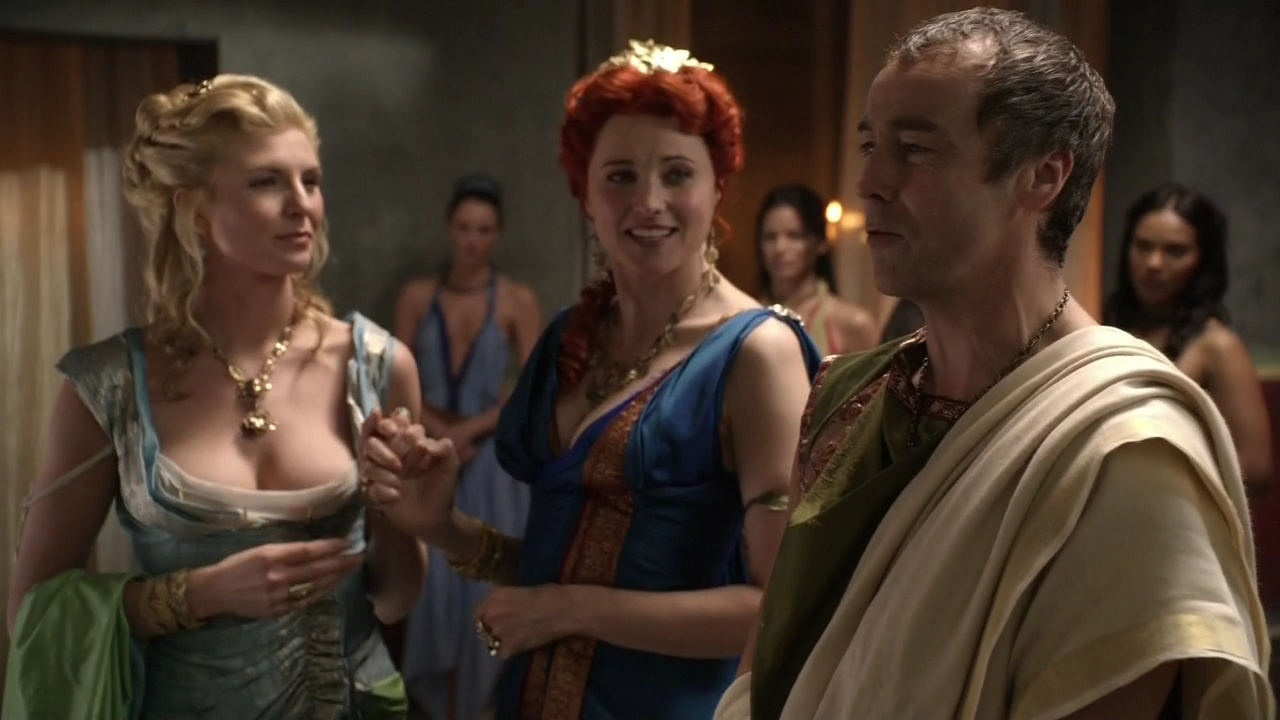
"words fall from your mouth as shit from arse" 

The composition beautiful. The language, eloquent. The sentiment, profound. 

The writer of the Shakespearean megalith, Spartacus: Blood and Sand, here is again displaying his exceptional talent for simulating human discourse, and yet simultaneously makes an intelligent philosophical point. Shit falls from arse. It is part of the natural cycle of creation, the unavoidable offense of voiding oneself. And yet it is somehow hideous, the equation of of the excremental act to speech offers profundity in the wholesale rejection of the words as naught but filth. Feces (Lation for 'sediment') is the great first means of creation to a child, proof of their ability to be more than passive recipients, and yet here that very creative spark is derided; their words are nothing but dregs, and all their great inventive potency and magic is wasted, they are but the rejections of the body, utterly useless, and nothing more.

Nevertheless the act of making stool is (generally) deliberate, an assertive evocation, and a symbol of domination. An image that is turned on it's head here. The shit here does nothing but 'fall' from arse; there is no action, no deliberate push, rather it merely slips from lo the crystal battlements and falls without intervention. The great assertive act has become nothing but the passivity of the dripping faucet; it is an emasculating insult, the victim has no control over either his words, or his shit. Excrement, that gold that is valued above all external commodities, has become unattainable to him. He is not only unable to control his words or his bodily functions, he is now also impoverished, his wealth in shit slipping from the grasp of his miser's arse like so many golden coins.

In the Roman context, this loss of Denarii is a critical insult. The target loses his wealth, his influence, and his entire life may well be at risk as a result. And yet there is a beauty to it in its simplicity. The symmetry of the sentence is undeniable. The four nouns act as punctuation points, each itself an epithet. They pin the sentence in place, and give it a very strong rhythm. The conjunction of arse and mouth reminds us that there is very little difference between the two, and 'words' and 'arse' at the beginning and end frame the phraseology of the piece, keeping it stripped down and nuanced, plain and clear.

The alliteration of the 'f' sound is onomatopoeic, mimicking the sound of shit literally falling from arse. The flat dropping sound resounds like the infertile speech of the target – it is nothing but a background noise, and so on a subliminal level his speech is further derided. By starting with 'words' there is already one trochaic foot, a falling sound that is echoed in the dropping pace. This too already introduces the mood of the falling shit, before the shit is even evoked.

Clearly I have merely scratched the surface of this poignant statement, but words cannot do justice to such a well constructed and considered triumph of the English language, exceeding even the championing creations of Milton, Donne or Wordsworth. Nay, it may even be the greatest poetry since time began and the firmament rose from the ocean itself to drape stars across the hopeless void.

Contemplations on Cock.

"the Gods part cheeks and ram COCK IN ARSE

The recurrent anal imagery again intercedes into dialogue, a poetic leif motif employed by the author that goes hand in hand with his explicit phallic imagery. The penetrative member here is divinely assisted, and yet it's presence is very much within arse; despite the characters expressive arm gestures, the final emphasis is not on the violation of penetration but the habitation of "cock in arse." possessing the anal cavity like the holy spirit inhabits the disciples, the cock is nevertheless a physical being. The author stresses the physical interplay of tactile forces, the pressing presence of the cock rammed against the wall of arse. It is both obscene aggression, the sinful presence that plays on the primal male fear of violation; the emasculation of sodomy and the disruption of the natural order. By conjuring the image of this inversion of primal unity, the author is attempting to unsettle his audience. What they had once taken for granted is now disturbed , the rhythm of the world is broken and the audience can now identify easily with the grief of the character. 
 
And yet there is something more to this than simple evocative imagery. The Gods themselves intervene in mortal affairs to 'part cheeks.' This divine assistance in an ultimately violent sodomy speaks to a deeper level. The Gods are representative of the world, of natural forces, and here the speaker laments how the entire world has turned against him, the Gods themselves participating in his anal intrusion. The once beatified deities that looked down upon and guided man in his endeavours have become nothing more than degenerate perverts, gleefully opening the way for the violation of the arse. There is something profoundly eschatological about this. It is as if the order of the Universe is crumbling, that what was once good is in decay, that new definitions of morality must be drawn in a pestilent world. The author is clearly dissatisfied with the state of creation, and laments the coming storm, and yet welcomes it as expiation from the moral degradation that has left the world naught but cock in arse.

The Superfluity of Certain Body Parts

 Case 1. The eyebrows. 

The yoke of mankind.
The eyebrows are perhaps one of the most pointless features ever to adorn the body. What is their purpose? Some misguided individuals may contend that they exist to capture perspiration, but would a gutter of flesh and bone above the eyes not be a better evolutionary development in this regard? No, these ridges of hairs have no design, no intent. They express emotion, but emotion is the bane to rational man. That is why the greatest scientists and thinkers such as Einstein, Nietzsche and Arius have tended to remove their eyebrows to enhance their mental prowess, and allow the ether unimpeded access to their frontal lobe.  To transcend the limitations imposed on us by our tyrannical eyebrows, we must remove these abominations from ourselves forthwith.  


Case 2. The Appendix 

Greater, less eyebrowed men than I have written on the superfluity of the appendix, so I shall not dwell upon it long. The appendix, the ticking time bomb nestled within each one of us exists, if it has purpose, as an allegory for our own sanity. Mostly we do not notice or care to notice it, nestled deep within us. It plays a negligible role in our dismal daily lives of incessant and fruitless action. And yet it is present there, waiting, with no function expect to break, to be ruptured. It is defined by it's own destruction. One day, for no apparent reason, our sanity, like our insidious appendix, may burst. Then any one of us may emerge like a rainbow Phoenix, nay, like a god in anguish, from the graying shell of existence, and see the world for what it is. They will be called degenerates, like the appendix labeled fruitless, and yet to them all creation and the kingdom have been revealed, and the only option is to have them removed, or like a diseased body, all social order will subside back into the dust and the shadows. 

Case 3. The Phallus. 

The phallus is not superfluous in any way. It is a symbol of the might of the Lord. 

Case 4. Bones 

It appears to me in my enlightened state that bones only restrict our ability to manoeuvre. Consider the mighty octopus; it lives the life of the great oceanic philosopher, and manages to do it all without the hindrance of bones. By removing our bones, we too can allow our bodies, as well as our minds, drift free from the bonds of a rigid, conforming structure. 


Case 5. The Body 

Gnosis teaches us that the body is entirely superfluous to our existence, in fact is a thing of evil, created in a handful of dust by an angry and inept God. If we allow the divine spark within us to transcend the limitations of mundus by the obliteration of our physical forms, the human race can finally escape the torment of the prison imposed upon it by the demiurge, and the tyranny of the angels. Therefore we must cast ourselves into the sea, every man, woman and child, of every creed and colour. It is the only way to be free.

Tuesday, 13 March 2012

Dawkins and the Knights Templar


The Knight’s Templar or ‘The Poor Fellow-Soldiers of Christ and of the Temple of Solomon’ as they are known in lerned circles, what became of them and where are they today?

The true cross, the Holy Grail, the authentic shroud of Turin, where are these relics and where are their pious guardians? I find it absurd to think that our LORD and saviour would allow these sacred artefacts to rust away in some ancient cellar, or to go to waste beneath the arid dunes of Palestine.

It was Bernard de Clairvaux in 1118, that first decreed the Order was to go underground in times of woe. As the power of the Catholic Church waned during the reformation and the enlightenment, these noble templar’s still stood guard, unseen like seraphim casting their protective gaze over their divine treasure.

So what of today? Bernard was no fool, he predicted the rise of Newton and Descartes, of Huxley, and Darwin and all those defamers of truth, that have a dozen heads each with a blasphemous name engraved upon it. Under his auspices a few templar’s of outstanding intellect were to begin their righteous masquerade, they would cloak themselves with the knowledge of eminent scientists, sceptics and doubting philosophers. They would pretend to be of the ilk of those very men they despised. They would pretend to be scientists, men of learning, and they would hide the grail and the true cross, where nobody would think to look, among the houses of those who had torn down Europe's churches brick by brick.

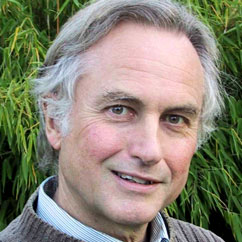
Richard Dawkins is one of these dignified men, I suspect he has the true cross in his basement, and when, (under circumstances I deem too banal to explain) I took off his shirt around a year ago, I saw a strange mark etched into his goodly frame, it appeared to me as a branding, a tau-cross. This cross belongs in a museum; we should reclaim it from him. 

Pious old fool

Sunday, 11 March 2012

Morrissey: Descendant of the Tetragrammaton?


Consider Morrissey.

Hi there, beautiful.


The greatest poet of our age, or perhaps any. At least the equivalent of Yeats, Milton, Shakespeare, or Chaucer. And his words are yet more beautiful, more visceral, more honest and nuanced than any of those lesser men. Is he the spawn of YHWH? It cannot be doubted. Consider his countenance. As the prophet Isaiah declared,

He had no beauty or majesty to attract us to him,
   nothing in his appearance that we should desire him.
He was despised and rejected by mankind,
   a man of suffering, and familiar with pain.
Like one from whom people hide their faces
   he was despised, and we held him in low esteem.

                                                                                                         Isaiah 53:2

Do you see? The great prophet predicted this, the hideous child of the Lord, the man despised, and held in low esteem, and yet so gifted, the great Servant of Jehovah. Was Morrissey not predicted millennia ago? No man on earth could fit this description more. Despite his Christ-like arrogance, Morrissey despises himself along with all humanity. When he considers the false prophet and heretic Jesus in his song, the humble “I Have Forgiven Jesus” he laments that

Jesus hurt me
When He deserted me

What a poet. And yet here he cuts deep to the heart of the misguided public’s relationship with the heathen Christ. He has deserted them like the liar he is. But now Morrissey has come for us, to deliver us and save us. To separate good from evil and to conquer the forces of darkness. And though he is reviled, who can argue that he is not the Son of God?


And like the true Son of God he will die for our iniquities. He describes his own martyrdom in grisly detail;

Monday - humiliation / Tuesday - suffocation
Wednesday - condescension / Thursday - is pathetic
by Friday - Life has killed me

This is what we as a society have driven poor, innocent Morrissey to. The lamb of God become our bloody sacrifice because we could not contain our wanton and repugnant lusts. They are a disease, a pox, a pestilence, and Morrissey fears even he has been tainted by being among us for so long;

why did you give me /so much desire?

Morrissey transcends his perpetual misanthropy by recognising himself as part of the corrupt whole, a whole body of humanity in decay, rotting in an open grave, a plague pit, a charnel house. Is there hope? Can Morrissey save us, even at the moment of our greatest evil?

I would argue not. We are beyond reprieve. Hence he has instead vested himself with the animals, and reduced himself to vegetarianism. To Morrissey, the innocent lambs and rabbits and calves and other animals frolicking in the fields are the true saved, the real children of Israel. These are the ones he will raise to the kingdom of heaven when he is martyred, not us. Not us.

Apart from swine. They’re filthy in the eyes of the supreme . And Morrissey knows that.